
Most people don’t realize how much variation exists in what moving companies actually offer. Some handle everything from packing to
junk removal. Others show up with a truck and expect you to have done the rest. Understanding the difference before you book saves you from a frustrating — and sometimes expensive — surprise on moving day.
This guide breaks down what moving services actually include at each level, what separates
professional movers from the rest, and what Suffolk County residents specifically should know before hiring anyone.
Most people start looking for movers when they’re already stressed. The lease is ending, the closing date is set, or something in life just shifted — and now there’s a move to plan on top of everything else. You search “moving services,” get a dozen results, and suddenly you’re comparing prices without really knowing what you’re comparing.
That’s the problem. Moving services isn’t one thing. It’s a spectrum — from a couple of guys with a truck to a full crew that packs your kitchen, wraps your furniture, and hauls away what you’re not taking. Knowing what’s actually included at each level is the only way to make a smart decision. Here’s how it breaks down.
What Full Service Moving Companies Actually Do
Full service moving companies handle the entire process — not just the heavy lifting. That means packing your belongings, wrapping and protecting furniture, disassembling and reassembling pieces as needed, loading the truck, transporting everything, and unloading and placing items at the destination. We also offer climate-controlled storage and junk removal in the same trip, which eliminates the need to coordinate multiple vendors.
The key word in “full service” is full. You shouldn’t have to touch a single box if you don’t want to. That’s the point. For people dealing with a tight timeline, a large home, specialty items like a piano or a safe, or simply not enough hours in the day, full service is often the most practical option — not just the most convenient one.
What Moving Help Actually Looks Like on Moving Day
There’s a wide range between “full service” and “I rented a truck and called two friends.” Most people land somewhere in the middle, and that’s where understanding your options matters most.
Labor-only moving help means you get trained movers who load and unload, but you’ve handled the packing yourself. This works well for people who have time to prep but don’t want to deal with the physical strain of moving heavy furniture. It’s also a common choice for smaller apartments where packing is manageable but carrying a couch down three flights isn’t.
Full packing services go further. A crew comes in and packs everything — dishes, clothing, books, fragile items — using proper materials and techniques that most people don’t have on hand. This matters more than it sounds. Improperly packed boxes are one of the most common sources of damage during a move, and it’s usually not the truck ride that causes the problem. It’s the packing.
Then there’s everything in between: partial packing (you handle the easy stuff, we handle the fragile or complex items), specialty item moving for things like pool tables or antiques, and combined moving and junk removal for people who are clearing out as they go. That last option is something we offer that most moving companies in Suffolk County don’t — one crew handles both the move and the removal of whatever you’re leaving behind, in a single trip. For anyone downsizing, settling an estate, or finally clearing out a basement that’s been accumulating since the 1970s, that combination saves real time and real money.
The right level of moving help depends on your timeline, your budget, and honestly, how much mental bandwidth you have left. A good moving company should be able to walk you through the options clearly and help you figure out what actually makes sense — not just push you toward the most expensive package.
How House Moving Companies Handle the Details Most People Don't Think About
The difference between a good move and a frustrating one usually comes down to the details — and most of them happen before the truck is even loaded.
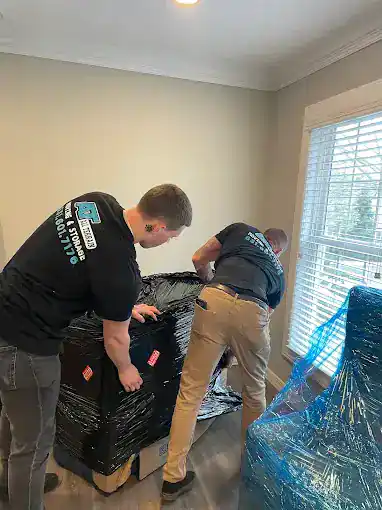
Professional house moving companies use equipment that protects both your belongings and your home. Floor-protecting bootees keep hardwood floors from getting scuffed or wet when crews are walking in and out. Shoulder dollies allow heavy items to be moved safely without dragging or improvising, which protects the item and the people carrying it. Furniture blankets and proper strapping prevent shifting in the truck. These aren’t extras — they’re the baseline of what a professional operation looks like.
Communication is another detail that matters more on moving day than people expect. When you’re directing a crew through your home, telling them which boxes go where, or explaining that the antique dresser needs extra care, you need to actually be understood. We run all-English-speaking crews specifically because miscommunication during a move isn’t just annoying — it leads to items ending up in the wrong rooms, instructions being missed, and mistakes that could have been avoided. It’s a practical decision, not a marketing point.
There’s also the question of who actually shows up. A lot of moving companies operate as brokers — they take your booking and subcontract the job to a third party. The crew that arrives may have no connection to the company you researched, no background checks on file, and no real accountability if something goes wrong. We employ our own people directly, on the books. That means consistent training, real accountability, and the same standard of work on every job. It’s a distinction worth asking about before you book anyone.
For Long Island homes specifically — many of which were built in the 1950s and 1960s with narrow hallways, tight staircases, and decades of accumulated contents — these details aren’t abstract. They’re what determines whether your move goes smoothly or turns into a problem you’re still dealing with a week later.
How to Know If a Moving Company Is Actually Legitimate
Licensing isn’t optional in this industry — it’s the baseline. In New York State, any company moving household goods intrastate needs to be licensed through the NYSDOT’s Intrastate Household Goods Moving Authority. For interstate moves, federal FMCSA registration is required. Both come with a verifiable USDOT number that any consumer can look up.
We hold DOT# 3706838 and MC# 1340650. Those numbers are searchable. That’s the point. A company that can’t or won’t provide them is a company you shouldn’t put your belongings in the back of.
What Suffolk County Residents Should Ask Before Hiring Movers
There are a few questions that will tell you more about a moving company than any website will.
Ask whether we’re a direct employer or a broker. Brokers are legal, but they hand your job off to whoever is available. You don’t know who’s coming. A direct employer sends their own trained crew — people they’ve vetted, hired, and are accountable for. We employ our own crew directly, so you know exactly who’s handling your move.
Ask about our estimate process. The FMCSA recommends that moving estimates be based on in-person inspections — not just a phone call or an online form. We offer in-person estimates because a quote based on actually seeing what you’re moving is a more accurate quote. That matters because we also guarantee that the final cost matches the original quote. No adjustments on moving day, no weight-based surprises, no discovering that the job suddenly requires more people or more hours than expected. What we quote is what you pay.
Ask about insurance. “We’re insured” is not enough of an answer. Ask whether we carry cargo insurance, whether we’re bonded, and what the process is if something gets damaged. We’re fully insured, bonded, and carry extensive cargo insurance — and we’re happy to explain what that covers.
For Suffolk County specifically, it’s also worth asking whether the company has real experience on Long Island. This isn’t just a local pride thing. The Northern State Parkway and Southern State Parkway don’t allow commercial vehicles or box trucks over seven feet. Movers without local experience find this out the hard way — and it adds time to your move. After 20 years of working across Suffolk County, from Ronkonkoma to the Hamptons, we know these roads and plan routes accordingly.
When to Book, What Timing Looks Like in Suffolk County, and What to Expect
Timing a move on Long Island has its own rhythm that people from outside the area don’t always account for.
Summer is the busiest season for movers everywhere, but in Suffolk County it’s amplified. From Memorial Day through Labor Day, the Hamptons market surges — seasonal rentals turn over, second-home purchases close, and estate moves pile up alongside the regular residential volume. If you’re moving between May and September, booking four to six weeks in advance is a reasonable target. Same-day availability exists but gets harder to guarantee as the summer progresses.
End-of-month moves are their own category. Most leases end on the last day of the month, which creates a predictable crunch. If your move date falls on the 30th or 31st, you’re competing with a lot of other people for the same scheduling window. The earlier you reach out, the more flexibility you have.
For people dealing with an emergency — a mover that cancelled, a closing that moved up, a situation that didn’t leave time to plan — we specifically offer same-day availability. Morning requests have the best chance of being accommodated. We’re available Monday through Sunday, 7:30am to 7pm, which means we can often fit in jobs that other companies can’t. One of the most common reviews we receive is from customers whose original mover cancelled the night before a move. We stepped in, showed up on time, and handled it. That’s not a one-time thing — it’s how we operate.
Off-peak months — October through April — typically offer more scheduling flexibility and, in some cases, better pricing. Winter moves in New York come with their own considerations (snow, ice, wet floors), but they’re very manageable with the right equipment and an experienced crew. Floor protection becomes especially important in winter when crews are tracking in slush, and it’s something we take seriously on every job regardless of season.
Choosing the Right Moving Services in Suffolk County, NY
Moving services range from basic loading help to a complete door-to-door operation — and the right choice depends on your situation, not on what sounds most impressive. What matters is that you understand what’s included before moving day, that the company you hire is licensed and accountable, and that the price you’re quoted is the price you actually pay.
After 20 years working across Suffolk County — from Islandia out to the Hamptons, from small apartments in Ronkonkoma to large homes along the North Shore — we’ve seen what makes moves go well and what makes them go sideways. It almost always comes down to preparation, communication, and the right crew.
If you’re trying to figure out what level of service makes sense for your move, or you just want a straight answer on what it would cost, reach out to us. We offer free in-person estimates, and we’re happy to walk you through the options without pressure.
Most people start looking for movers when they’re already stressed. The lease is ending, the closing date is set, or something in life just shifted — and now there’s a move to plan on top of everything else. You search “moving services,” get a dozen results, and suddenly you’re comparing prices without really knowing what you’re comparing.
That’s the problem. Moving services isn’t one thing. It’s a spectrum — from a couple of guys with a truck to a full crew that packs your kitchen, wraps your furniture, and hauls away what you’re not taking. Knowing what’s actually included at each level is the only way to make a smart decision. Here’s how it breaks down.
What Full Service Moving Companies Actually Do
Full service moving companies handle the entire process — not just the heavy lifting. That means packing your belongings, wrapping and protecting furniture, disassembling and reassembling pieces as needed, loading the truck, transporting everything, and unloading and placing items at the destination. We also offer climate-controlled storage and junk removal in the same trip, which eliminates the need to coordinate multiple vendors.
The key word in “full service” is full. You shouldn’t have to touch a single box if you don’t want to. That’s the point. For people dealing with a tight timeline, a large home, specialty items like a piano or a safe, or simply not enough hours in the day, full service is often the most practical option — not just the most convenient one.
What Moving Help Actually Looks Like on Moving Day
There’s a wide range between “full service” and “I rented a truck and called two friends.” Most people land somewhere in the middle, and that’s where understanding your options matters most.
Labor-only moving help means you get trained movers who load and unload, but you’ve handled the packing yourself. This works well for people who have time to prep but don’t want to deal with the physical strain of moving heavy furniture. It’s also a common choice for smaller apartments where packing is manageable but carrying a couch down three flights isn’t.
Full packing services go further. A crew comes in and packs everything — dishes, clothing, books, fragile items — using proper materials and techniques that most people don’t have on hand. This matters more than it sounds. Improperly packed boxes are one of the most common sources of damage during a move, and it’s usually not the truck ride that causes the problem. It’s the packing.
Then there’s everything in between: partial packing (you handle the easy stuff, we handle the fragile or complex items), specialty item moving for things like pool tables or antiques, and combined moving and junk removal for people who are clearing out as they go. That last option is something we offer that most moving companies in Suffolk County don’t — one crew handles both the move and the removal of whatever you’re leaving behind, in a single trip. For anyone downsizing, settling an estate, or finally clearing out a basement that’s been accumulating since the 1970s, that combination saves real time and real money.
The right level of moving help depends on your timeline, your budget, and honestly, how much mental bandwidth you have left. A good moving company should be able to walk you through the options clearly and help you figure out what actually makes sense — not just push you toward the most expensive package.
How House Moving Companies Handle the Details Most People Don't Think About
The difference between a good move and a frustrating one usually comes down to the details — and most of them happen before the truck is even loaded.
Professional house moving companies use equipment that protects both your belongings and your home. Floor-protecting bootees keep hardwood floors from getting scuffed or wet when crews are walking in and out. Shoulder dollies allow heavy items to be moved safely without dragging or improvising, which protects the item and the people carrying it. Furniture blankets and proper strapping prevent shifting in the truck. These aren’t extras — they’re the baseline of what a professional operation looks like.
Communication is another detail that matters more on moving day than people expect. When you’re directing a crew through your home, telling them which boxes go where, or explaining that the antique dresser needs extra care, you need to actually be understood. We run all-English-speaking crews specifically because miscommunication during a move isn’t just annoying — it leads to items ending up in the wrong rooms, instructions being missed, and mistakes that could have been avoided. It’s a practical decision, not a marketing point.
There’s also the question of who actually shows up. A lot of moving companies operate as brokers — they take your booking and subcontract the job to a third party. The crew that arrives may have no connection to the company you researched, no background checks on file, and no real accountability if something goes wrong. We employ our own people directly, on the books. That means consistent training, real accountability, and the same standard of work on every job. It’s a distinction worth asking about before you book anyone.
For Long Island homes specifically — many of which were built in the 1950s and 1960s with narrow hallways, tight staircases, and decades of accumulated contents — these details aren’t abstract. They’re what determines whether your move goes smoothly or turns into a problem you’re still dealing with a week later.
How to Know If a Moving Company Is Actually Legitimate
Licensing isn’t optional in this industry — it’s the baseline. In New York State, any company moving household goods intrastate needs to be licensed through the NYSDOT’s Intrastate Household Goods Moving Authority. For interstate moves, federal FMCSA registration is required. Both come with a verifiable USDOT number that any consumer can look up.
We hold DOT# 3706838 and MC# 1340650. Those numbers are searchable. That’s the point. A company that can’t or won’t provide them is a company you shouldn’t put your belongings in the back of.
What Suffolk County Residents Should Ask Before Hiring Movers
There are a few questions that will tell you more about a moving company than any website will.
Ask whether we’re a direct employer or a broker. Brokers are legal, but they hand your job off to whoever is available. You don’t know who’s coming. A direct employer sends their own trained crew — people they’ve vetted, hired, and are accountable for. We employ our own crew directly, so you know exactly who’s handling your move.
Ask about our estimate process. The FMCSA recommends that moving estimates be based on in-person inspections — not just a phone call or an online form. We offer in-person estimates because a quote based on actually seeing what you’re moving is a more accurate quote. That matters because we also guarantee that the final cost matches the original quote. No adjustments on moving day, no weight-based surprises, no discovering that the job suddenly requires more people or more hours than expected. What we quote is what you pay.
Ask about insurance. “We’re insured” is not enough of an answer. Ask whether we carry cargo insurance, whether we’re bonded, and what the process is if something gets damaged. We’re fully insured, bonded, and carry extensive cargo insurance — and we’re happy to explain what that covers.
For Suffolk County specifically, it’s also worth asking whether the company has real experience on Long Island. This isn’t just a local pride thing. The Northern State Parkway and Southern State Parkway don’t allow commercial vehicles or box trucks over seven feet. Movers without local experience find this out the hard way — and it adds time to your move. After 20 years of working across Suffolk County, from Ronkonkoma to the Hamptons, we know these roads and plan routes accordingly.
When to Book, What Timing Looks Like in Suffolk County, and What to Expect
Timing a move on Long Island has its own rhythm that people from outside the area don’t always account for.
Summer is the busiest season for movers everywhere, but in Suffolk County it’s amplified. From Memorial Day through Labor Day, the Hamptons market surges — seasonal rentals turn over, second-home purchases close, and estate moves pile up alongside the regular residential volume. If you’re moving between May and September, booking four to six weeks in advance is a reasonable target. Same-day availability exists but gets harder to guarantee as the summer progresses.
End-of-month moves are their own category. Most leases end on the last day of the month, which creates a predictable crunch. If your move date falls on the 30th or 31st, you’re competing with a lot of other people for the same scheduling window. The earlier you reach out, the more flexibility you have.
For people dealing with an emergency — a mover that cancelled, a closing that moved up, a situation that didn’t leave time to plan — we specifically offer same-day availability. Morning requests have the best chance of being accommodated. We’re available Monday through Sunday, 7:30am to 7pm, which means we can often fit in jobs that other companies can’t. One of the most common reviews we receive is from customers whose original mover cancelled the night before a move. We stepped in, showed up on time, and handled it. That’s not a one-time thing — it’s how we operate.
Off-peak months — October through April — typically offer more scheduling flexibility and, in some cases, better pricing. Winter moves in New York come with their own considerations (snow, ice, wet floors), but they’re very manageable with the right equipment and an experienced crew. Floor protection becomes especially important in winter when crews are tracking in slush, and it’s something we take seriously on every job regardless of season.
Choosing the Right Moving Services in Suffolk County, NY
Moving services range from basic loading help to a complete door-to-door operation — and the right choice depends on your situation, not on what sounds most impressive. What matters is that you understand what’s included before moving day, that the company you hire is licensed and accountable, and that the price you’re quoted is the price you actually pay.
After 20 years working across Suffolk County — from Islandia out to the Hamptons, from small apartments in Ronkonkoma to large homes along the North Shore — we’ve seen what makes moves go well and what makes them go sideways. It almost always comes down to preparation, communication, and the right crew.
If you’re trying to figure out what level of service makes sense for your move, or you just want a straight answer on what it would cost, reach out to us. We offer free in-person estimates, and we’re happy to walk you through the options without pressure.