

Summary:
You’ve probably seen the ads. A container gets dropped in your driveway, you load it at your own pace, and someone else drives it to your new place. Simple, right?
On paper, moving pods sound like a smart, affordable alternative to hiring movers. But once you start adding up the real costs — delivery fees, pickup fees, loading labor, permits, insurance, and the risk of a billing cycle that doesn’t care about your closing date — the picture gets more complicated.
This guide breaks down what moving pods actually cost in 2026, what full-service moving typically runs in Suffolk County, and how to figure out which option is the better fit for your situation.
Moving Pods Cost Breakdown: What You're Actually Paying in 2026
The base quote for a moving pod can look reasonable — somewhere between $220 and $800 for a local move under 50 miles, and $1,000 to $7,448 for longer distances, depending on container size and how far you’re going. The median cost across all PODS moves in 2026 sits around $4,511. That number sounds manageable until you realize it’s just the starting point.
Delivery and pickup are billed separately, typically $75 to $150 each way. Monthly storage runs $149 to $359 depending on container size. And if your move runs one day into a new billing cycle — because your closing got pushed back or the container sat in transit longer than expected — you’re paying for a full additional month, not a prorated day.
None of that accounts for loading help, permits, or insurance. Those come next.
Hidden Moving Pod Costs Suffolk County Homeowners Often Miss
Here’s the part that catches people off guard: pod companies don’t load your stuff. Their drivers are prohibited from helping. So unless you’re planning to move a full household by yourself, you’ll need to hire separate loading labor — and in Suffolk County, that runs between $379 and $790 depending on the job.
Then there’s the permit question. Placing a container on a public street in Suffolk County requires a permit from your specific town — and every town handles it differently. Huntington, Babylon, Islip, Smithtown, and Brookhaven each have their own process, their own fees, and their own timelines. If your driveway can accommodate the container, you may avoid this entirely. But a standard pod needs 40 or more feet of clear driveway space and adequate overhead clearance. A lot of properties in older neighborhoods — parts of Amityville, Lindenhurst, or Bay Shore — simply don’t have that.
HOAs are another issue that doesn’t come up until it’s too late. Suffolk County has a high concentration of HOA-governed communities, especially in Hauppauge, Nesconset, Lake Grove, and numerous 55-plus developments. Many of them explicitly prohibit portable storage containers on the property. You won’t know until you’ve already scheduled the delivery.
And then there’s insurance. Contents protection is not included in the base pod quote — it’s an optional add-on. Your homeowner’s or renter’s policy may cover items in transit, but many don’t, and the standard moving liability coverage that comes by default is $0.60 per pound. A 50-pound flat-screen TV worth $900 would be covered for $30.
When you add loading labor, permits, insurance, and the realistic possibility of an extra storage month, a pod move that looked like $2,000 can land well north of $3,500 before you’ve unpacked a single box.
Moving Prices in 2026: How Full-Service Movers Compare
Full-service movers charge by the hour or by the job, and rates vary by crew size, distance, and what’s involved. In 2026, local professional movers typically run $25 to $50 per mover per hour. A studio or one-bedroom local move usually comes in between $200 and $600. A two-bedroom home runs $700 to $1,400 for most local jobs in Suffolk County. Moving company pricing has risen about 21% this year due to fuel costs, so if you got a quote a year ago, it’s worth getting a fresh one.
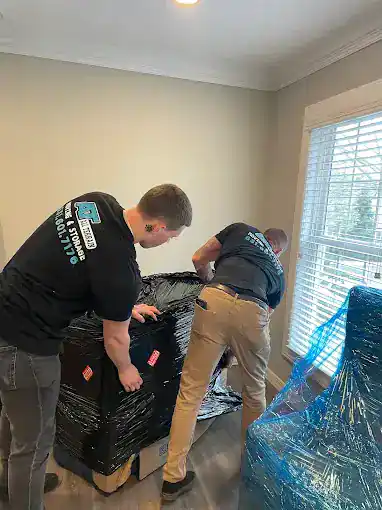
What those numbers include matters. A legitimate full-service mover shows up with a truck, blankets, straps, dollies, and a trained crew. Furniture gets wrapped and protected. Heavy items get handled with proper equipment. You don’t need to hire anyone separately, coordinate a second company, or figure out loading logistics on your own.
For most Suffolk County homeowners — especially those moving out of a house they’ve lived in for ten or twenty years, with a full basement, a garage, and a lifetime of accumulated belongings — the all-in cost of a pod move and the all-in cost of full-service moving are closer than most people expect. And one of them involves a lot more work on your end.
It’s also worth noting that full-service packing, if you want it, typically adds 30 to 50 percent to the base quote. But professional packers can complete an average home in six to eight hours. That’s time you’re not spending pulling your back out over a 16-foot container in your driveway.
Storage Container Movers vs. Full-Service Teams: What the Difference Looks Like on Moving Day
The practical gap between container moving and full-service moving becomes clearest when something doesn’t go according to plan — which, in most moves, is a matter of when, not if.
With a pod, you’re coordinating between the container company, the separate loading crew you hired, the permit office, and whatever’s happening with your closing. With a full-service team, one company handles all of it. We show up, we load, we transport, we unload. If something needs to change, you make one call.
That simplicity has real value, especially when you’re already managing a home sale, a new purchase, and everything else that comes with moving in Suffolk County.
Why Crew Coordination Matters More Than Most People Realize
Moving day is a real-time communication event. When the crew is carrying your grandmother’s antique dresser up a narrow staircase, or navigating a baby grand piano through a doorway with two inches of clearance, the instructions you give need to be understood immediately and executed precisely.
This is one of the reasons we staff all English-speaking crews on every job. It’s not a small thing. Miscommunication during a move doesn’t just cause delays — it causes damage. A crew that can’t confirm which room something goes in, or doesn’t understand that a particular piece needs to be tilted a specific way, creates problems that are expensive and sometimes irreversible.
Beyond the communication piece, there’s the equipment. We use floor-protecting bootees, shoulder dollies, furniture blankets, and proper straps on every move. These aren’t optional upgrades — they’re standard. The bootees protect your hardwood floors from scratches during loading and unloading. The shoulder dollies let two people safely carry items that would otherwise require three or four, reducing the chance of a drop. These details don’t sound exciting, but they’re the difference between a move where nothing gets damaged and one where you’re filing a claim.
The other thing worth understanding is who’s actually doing the work. We employ trained, on-the-books professionals — not day laborers or subcontractors pulled from a staffing app. That distinction matters for accountability. If something goes wrong on your move, there’s a real company with real cargo insurance to make it right. That’s not always the case with budget movers, and it’s never the case with a pod where you hired loading help separately.
For moves involving high-value items — whether that’s a home in Smithtown with custom furniture, or a Hamptons property with art and antiques — the crew quality and equipment aren’t negotiable. The cost of getting it wrong is too high.
Moving Company Cost in Suffolk County: When Full-Service Is the Smarter Call
There are situations where a pod makes sense. If you’re moving a small amount of belongings a long distance, you have a suitable driveway, your HOA allows it, and you’re physically capable of loading everything yourself, the math can work in your favor. That’s a real scenario for some people.
But for the typical Suffolk County move — a family relocating from a three-bedroom colonial in Commack to a new home in Ronkonkoma, or a longtime resident downsizing from a house in Deer Park to something smaller in Holbrook — the full-service route is usually the more practical and often the more affordable option once everything is accounted for.
One thing we offer that changes the calculation for a lot of homeowners is the ability to handle the move and the junk removal in a single trip. Most people who’ve lived in a Suffolk County house for more than a few years have things they need to get rid of before they move — furniture that’s not coming with them, appliances in the basement, boxes in the attic that haven’t been opened since the Clinton administration. Renting a dumpster, making multiple dump runs, or scheduling a separate junk removal company adds cost and complexity to an already complicated process. We can handle both in one appointment.
We also offer climate-controlled, secured storage for situations where your move-out and move-in dates don’t line up cleanly. This comes up constantly in Suffolk County, where closing delays are common and the gap between leaving your old home and getting into the new one can stretch from days to weeks. Our storage option keeps your belongings in a controlled environment — not in a steel container sitting in a parking lot somewhere — and the billing doesn’t punish you for a one-day overrun.
Every job we take starts with an in-person estimate. We come to your home, see what you have, understand what the move actually involves, and give you a quote based on reality. And that quote is what you pay — the final cost matches the original quote, guaranteed. In an industry where surprise fees on delivery day are a documented and common problem, that guarantee is worth something.
We’ve been doing this for 20 years, and we’re based in Islandia — right in the middle of Suffolk County, close to the LIE at Exit 57. We know the roads, we know the neighborhoods, and we know the specific logistics of moving in this part of Long Island in a way that a national container company dispatching from a regional hub simply doesn’t.
Which Moving Option Is Right for Your Suffolk County Move?
Pods aren’t a scam. But they’re also not the straightforward, budget-friendly solution the marketing makes them look like — especially for a full household move in Suffolk County, where permits, HOA rules, driveway requirements, and the cost of separate loading labor can quietly push the total well past what you expected.
Full-service moving costs more upfront in some cases. But it includes the labor, the equipment, the coordination, and the accountability that a container company doesn’t provide. For most moves in this county, the gap between the two options is smaller than people assume — and the difference in what you actually have to do is enormous.
If you’re trying to figure out what your specific move would cost, the best next step is a real conversation with someone who can look at your situation and give you an honest number. We offer in-person estimates, seven days a week, and the final price you’re quoted is the price you pay. Reach out and find out what your move actually looks like.