Summary:
Most moves go fine — until they don’t. The dresser that seemed manageable turns out to weigh 300 lbs. The gun safe needs to come down a narrow staircase with a 90-degree turn at the bottom. The antique armoire has a finish that won’t survive contact with a door frame.
Heavy furniture transport isn’t just about strength. It’s about knowing what equipment to bring, how to read a room before anything gets lifted, and how to move through a real home — with real floors, real walls, and real consequences — without causing damage. Here’s what that actually looks like in practice.
What Professional Furniture Transport Actually Involves
There’s a big difference between moving furniture and moving it well. Professional furniture transport starts before anything gets lifted — with an honest assessment of the item, the route, and the potential problem points along the way.
That means measuring doorway widths, identifying tight corners, checking stair configurations, and knowing what the floor surface is before a single dolly wheel touches it. A crew that skips this step is guessing. And when you’re dealing with a 500-lb safe or a century-old sideboard, guessing isn’t good enough.
The equipment matters just as much as the planning. Floor-protecting bootees, shoulder dollies, furniture pads, stretch wrap, ratchet straps — these aren’t optional extras. They’re what separates a move that goes smoothly from one that ends with a claim.
What Equipment Do We Use for Heavy Furniture Moves?
Walk through what we bring to a heavy furniture move and you’ll understand quickly why the right equipment makes such a difference.
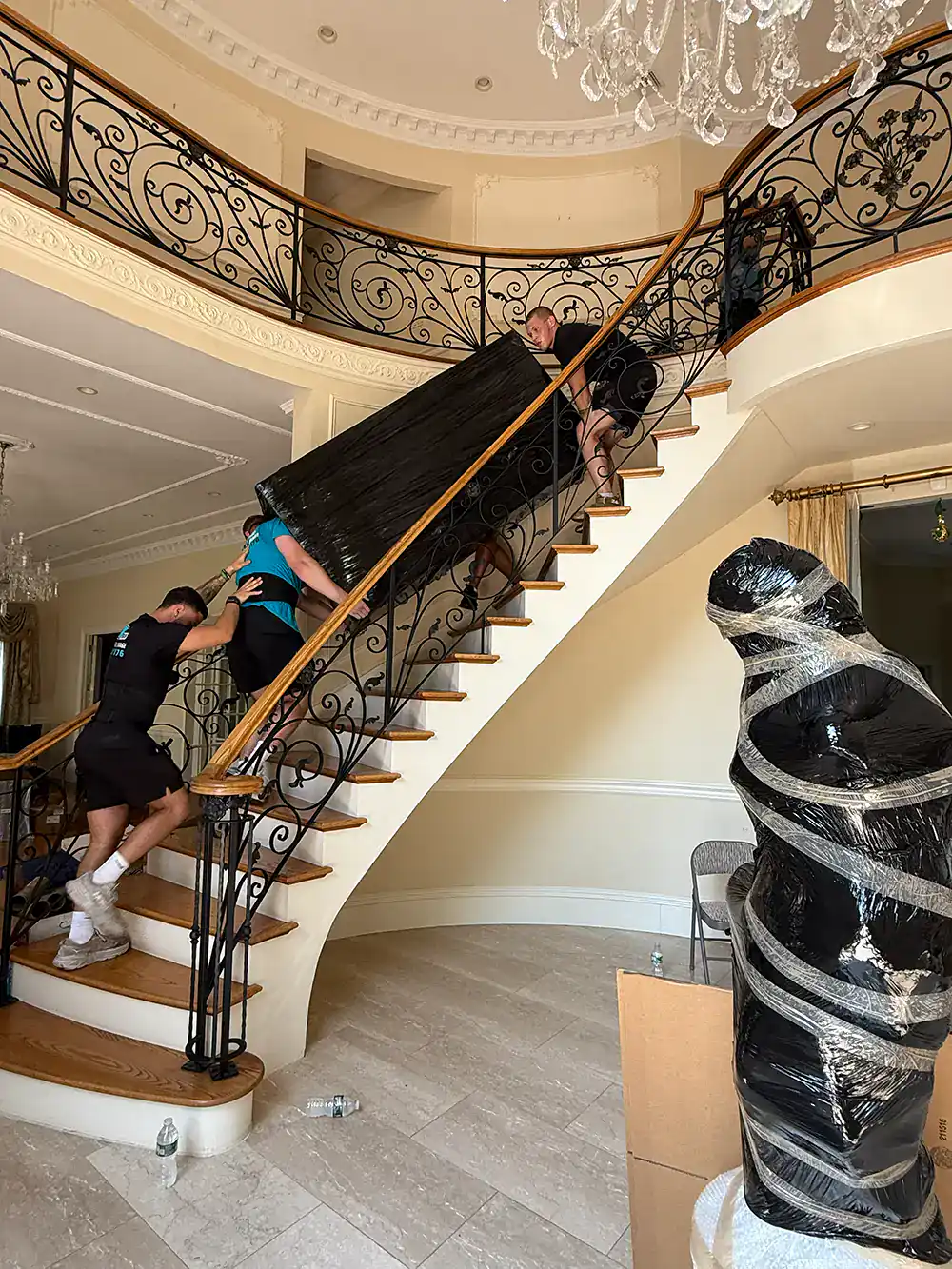
Shoulder dollies — sometimes called lifting straps — are one of the most important tools for heavy or awkward pieces. Rather than relying on grip strength alone, they distribute the weight across both movers’ bodies, which means better control through tight spaces and far less risk of dropping something mid-carry. On a Long Island colonial with a narrow staircase and a landing that barely fits two people side by side, this matters enormously.
Four-wheel furniture dollies handle the horizontal work — moving heavy pieces across floors without dragging. The key detail here is non-marking wheels. A dolly with the wrong wheels will leave tracks across hardwood or damage tile. Our professional-grade dollies are built specifically to avoid this, which is why the equipment we bring tells you a lot about how seriously we take floor protection.
For stairs, appliance dollies with straps handle tall, heavy items that need to stay vertical — refrigerators, armoires, large safes. Some moves require motorized stair climbers for items that exceed what a two-person carry can safely manage. This is specialized equipment that you won’t find at a consumer rental outlet, and it’s one of the clearest dividing lines between a professional operation and someone with a rented truck.
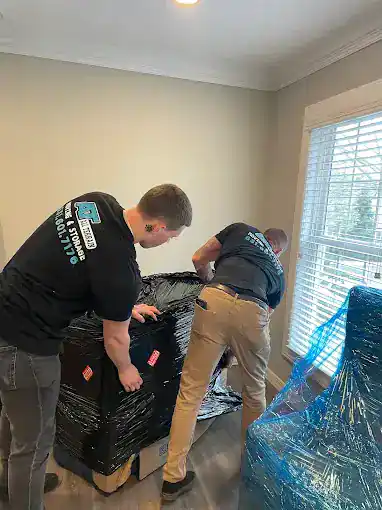
Moving blankets and furniture pads wrap around pieces before they go anywhere near a doorframe or a truck wall. Stretch wrap goes over the blankets to hold them in place without using tape that could damage finishes. Ratchet straps secure everything inside the truck so nothing shifts in transit — because a piece of furniture that slides three feet during a hard stop on the LIE can arrive damaged even if the loading was perfect.
Floor-protecting bootees are placed under furniture legs before any piece is set down. It’s a small detail that prevents the kind of scratch that ruins a hardwood floor — and it’s the kind of thing that our experienced crews do automatically, not as an afterthought.
Why Loading Sequence Inside the Truck Affects Whether Your Furniture Arrives Safely
How furniture gets loaded into the truck is just as important as how it gets out of the house. A crew that loads randomly is setting up problems that won’t show up until unloading — when a lighter piece has been sitting under something that weighs four times as much for the past two hours.
The correct sequence puts the heaviest items in first, positioned against the cab wall. This keeps the truck’s weight distribution stable during transit and prevents the load from shifting forward during braking. Tall items get strapped vertically against the walls. Lighter, more fragile pieces go on top or in the remaining space, with padding between anything that could make contact.
This matters especially for antique furniture, which often has joinery and finishes that can’t handle pressure from the wrong direction. A well-loaded truck means a piece of furniture that was in perfect condition when it left your house in Commack or Huntington arrives at the destination in the same condition — not with a stress crack in the frame or a compression mark in the upholstery.
It also matters for our efficiency. A properly loaded truck unloads faster and more safely, which keeps the job on schedule and reduces the chance of rushed handling at the end of a long day. Good loading is invisible when it works — you only notice bad loading when something goes wrong.
Gun Safe Moving Company: What Suffolk County Homeowners Need to Know
Gun safes are in a category of their own when it comes to furniture transport. A small safe might weigh 200 lbs. A mid-size model commonly runs 400–600 lbs. Large gun safes can reach 1,500 lbs or more — and they’re dense, with a center of gravity that makes them genuinely difficult to control without the right equipment and the right number of people.
New York State requires safe storage of firearms, which means a lot of Suffolk County households own gun safes. And when those households move — whether from Smithtown to the Hamptons or from a house in Babylon to a condo in Ronkonkoma — the safe has to come with them. That’s not a job for a standard moving crew without specialty equipment.
How We Move a Gun Safe
The process starts with an in-person assessment. We won’t quote a gun safe move over the phone without seeing the safe, the staircase, and the exit route. The weight of the safe, the width of the doorways, the number of stairs, the surface of the floors — all of it affects how we plan and execute the move.
Once we’re on-site, the first step is floor protection. Bootees go under the safe’s base, and protective runners go down on any hardwood or tile surfaces along the route. The safe doesn’t move until the floor is protected. This isn’t overcaution — a 600-lb object moving across an unprotected hardwood floor can leave damage that costs more to repair than the move itself.
Stair climbers or heavy-duty appliance dollies handle the vertical movement. For safes over a certain weight, this requires a motorized stair climber that can bear the load mechanically rather than relying entirely on crew strength. This is the equipment that makes a difficult move manageable — and its absence is what makes some moves go badly wrong.
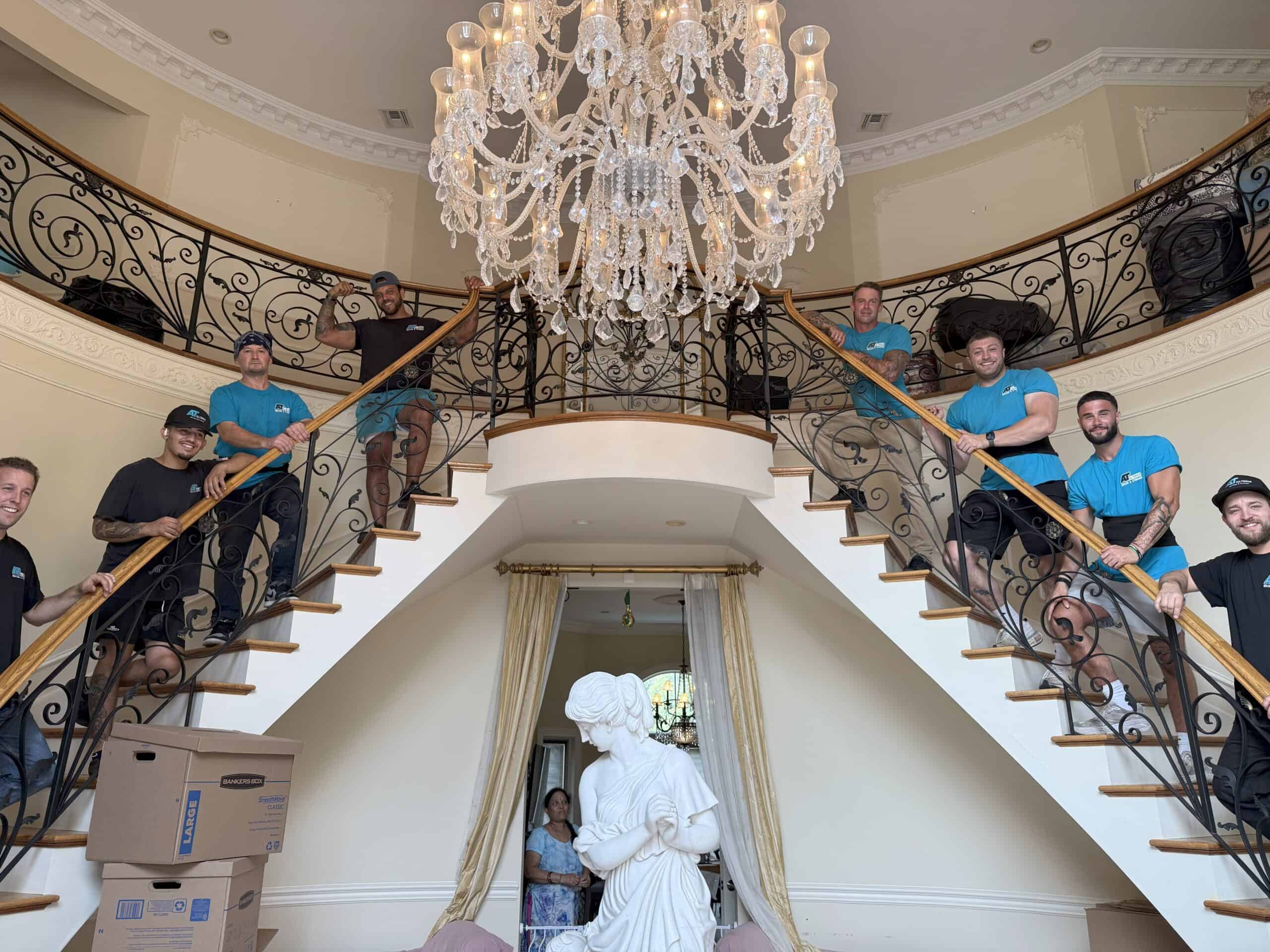
Clear communication between crew members is non-negotiable during a gun safe move. When a 500-lb safe is halfway down a staircase, everyone involved needs to be responding to the same instructions in real time. This is one of the concrete reasons why working with an all English-speaking crew matters — not as a marketing point, but as a practical reality of how complex moves get executed safely.
The final step is placement. Gun safes often need to be positioned precisely — against a specific wall, in a corner, on a certain floor surface. Getting a safe into the right spot without damaging the floor or the surrounding walls requires patience and coordination, not just raw effort.
How Much Does It Cost to Move a Gun Safe in Suffolk County?
For a local move within Suffolk County — say, from a home in Hauppauge to one in Medford — the typical cost to move a gun safe runs somewhere between $200 and $500, depending on the weight of the safe, the number of stairs involved, and the complexity of the route. That range reflects a straightforward local move with a professional crew and proper equipment.
Long-distance moves are priced differently. When a safe is going across state lines or a significant distance, cost is calculated based on weight and mileage, and it increases accordingly.
What that cost covers matters. Our gun safe moves include the right equipment, adequate crew size, floor protection throughout, and the expertise to handle unexpected complications — a doorway that’s two inches narrower than expected, a staircase with a turn that wasn’t visible in photos, a floor surface that needs extra protection. When you work with us, those complications get solved on the spot rather than turning into damage claims.
One thing worth understanding about the Suffolk County market specifically: a lot of the homes here were built in the mid-20th century, and the interior dimensions reflect that era. Colonial staircases in Dix Hills or Northport aren’t built to accommodate modern gun safes. Neither are the narrow hallways in some of the older ranch-style homes in central Suffolk. Our crew has dealt with these configurations before and knows how to plan around them — which is a meaningful advantage over a company that’s never worked this market.
The bottom line on cost is this: the quote you get should reflect the actual job, not a number designed to win your business and grow at the end. An in-person estimate — where someone actually sees the safe, the stairs, and the exit route before quoting — produces a number you can rely on. A phone estimate for a gun safe move is a guess, and it’s usually a low one.
Choosing the Right Furniture Transport Service in Suffolk County
Heavy furniture transport comes down to preparation, equipment, and experience. The right crew shows up knowing what they’re dealing with, brings the tools to handle it properly, and protects your floors and your belongings throughout the process. That’s not a high bar — it’s just what a professional move should look like.
For Suffolk County homeowners dealing with gun safes, antiques, pianos, or anything else that can’t be replaced, the stakes are real. A scratch in a hardwood floor, a crack in a century-old finish, a safe dropped on a staircase landing — these aren’t hypotheticals. They happen when the wrong crew takes on a job they’re not equipped for.
If you’re planning a move in Suffolk County and want a crew that’s done this before — with the equipment, the experience, and a final cost that matches the quote — reach out to us at All Terrain Moving and Junk Removal Inc. We’re based in Islandia and serve the full county, from Huntington to Montauk, seven days a week.