Summary:
Most business owners don’t think about the real cost of a move until they’re in the middle of one. It’s not just the trucks and the boxes — it’s the hours your team can’t work, the clients who can’t reach you, and the equipment that’s somewhere between two addresses. A commercial relocation done poorly can set a business back weeks. Done right, your team walks into the new space on Monday and barely skips a beat. This guide covers what that actually looks like — the planning, the timing, the decisions that matter — and what your business in Suffolk County specifically needs to know before you start.
What Makes Business Relocations Different From Any Other Move
A residential move has a finish line: get everything in, unpack, done. A commercial move has a finish line too, but there are people, systems, and revenue attached to every hour it takes to cross it. Your employees need workstations. Your phones need to ring. Your clients need to feel nothing changed.
That’s the core challenge of business relocations — the physical move is only part of the job. The rest is coordination: who moves when, what gets packed last, which equipment gets reconnected first, and how you communicate all of it to a team that still has work to do while the transition is happening. Getting that sequence right is what separates a one-day disruption from a two-week recovery.
Relocation Movers Who Actually Manage the Process — Not Just the Truck
There’s a version of commercial moving where the movers show up, load the truck, and leave — and you figure out the rest. That version works fine for a studio apartment. For a business, it creates chaos.
What you actually need from relocation movers is project management alongside the physical labor. That means an in-person walkthrough before moving day, not a phone estimate based on square footage. It means a labeled system so every box, every monitor, every filing cabinet lands in the right room at your new location. It means someone on the crew who knows what’s going where and can answer your questions without stopping to call the office.
On the logistics side, commercial moves in Suffolk County come with their own layer of complexity. Buildings in the Hauppauge Industrial Park, for example, often have specific loading dock windows and require advance coordination with building management. Office towers along the Route 110 corridor in Melville may require elevator reservations and parking permits for commercial vehicles. A mover who hasn’t done this before will figure it out on your dime — and your time.
IT is the other piece most businesses underestimate. Furniture being in the wrong room is an inconvenience. Servers being offline, cables being tangled, or monitors being damaged in transit is a real operational problem. The physical transport of furniture is rarely what causes post-move downtime — it’s the technology disruption. We coordinate around your IT setup and teardown timeline, not the other way around.
We’ve handled moves for professional offices in Smithtown, medical practices in Huntington, and companies operating out of the Hauppauge Industrial Park. The buildings are different, the timelines are different, and the requirements are different — but the goal is always the same: your people are working again as fast as possible.
Phased Moving vs. Single-Day Relocation — Which One Is Right for Your Business?
The assumption most businesses make is that a move happens in a day. You clear out Friday, you’re set up Monday. That works for some operations — smaller teams, simpler setups, spaces that are ready to go on both ends. But for a lot of Suffolk County businesses, a phased approach is actually the smarter move.
Phased relocation means moving by department, by function, or by floor over multiple days or weekends. Your accounting team moves first. Your operations team follows the next weekend. Your IT infrastructure is the last thing to go, reconnected and tested before anyone else arrives. Throughout the whole process, your core business functions stay online because not everything is in transit at the same time.
This approach works especially well for businesses in multi-tenant office buildings — which are common along Veteran’s Memorial Highway in Ronkonkoma and in the commercial corridors around Islandia and Central Islip. Building access windows are limited, elevator time is shared, and loading docks have schedules. Phasing the move around those constraints keeps things moving without turning into a bottleneck.
The weekend move is another tool worth understanding. If your team works Monday through Friday, a Friday-evening-to-Sunday move means you’re not pulling anyone away from client work, and Monday morning looks almost normal. We’re available seven days a week, from 7:30 in the morning to 7 at night, specifically because that’s when commercial clients need us — not necessarily during the standard nine-to-five window.
The honest answer to which approach is right for you depends on your team size, your equipment, your new space, and your timeline. That’s exactly why we do in-person estimates rather than phone quotes — because the right plan for a twelve-person law firm in Smithtown looks nothing like the right plan for a forty-person company relocating out of a Melville office park.
Emergency Business Relocations in Suffolk County — When You Don't Have Weeks to Plan
Not every commercial move is scheduled six months out. Leases end unexpectedly. Facilities become unusable. A landlord sells the building. Another mover cancels the night before. These situations happen more often than people expect, and when they do, your business still has to move — ready or not.
Emergency relocation is a different kind of pressure. The timeline is compressed, the decisions are fast, and the margin for error is small. Having a mover with same-day availability and the experience to execute under those conditions isn’t a luxury — it’s the difference between keeping your business intact and losing days of revenue while you scramble.
What Same-Day Commercial Moving Actually Looks Like
Same-day availability sounds like a marketing line until you actually need it. When a pipe bursts in your Ronkonkoma office on a Thursday morning, or your landlord in Hauppauge gives you a hard deadline you didn’t see coming, same-day capability is the only thing standing between you and a serious problem.
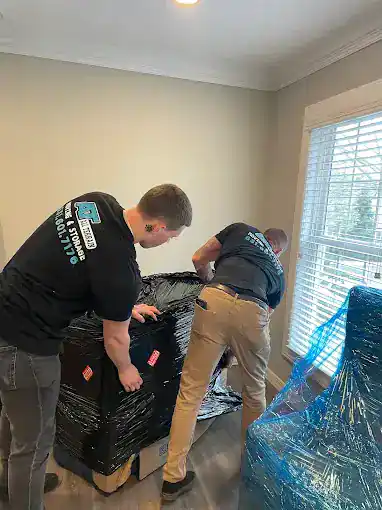
What makes it work isn’t just having trucks available — it’s having crews who know how to move fast without cutting corners. That means professional, on-the-books employees who’ve done this before, not day laborers pulled in at the last minute. It means equipment that’s ready to go: shoulder dollies, proper wrapping materials, floor-protecting bootees that keep your building’s floors and doorframes intact even when the pace is quick. Commercial landlords in Suffolk County’s office parks take property damage seriously, and a rushed move that leaves marks on a hardwood floor or chips a doorframe can cost you a security deposit you can’t afford to lose.
It also means clear communication throughout. Our crews are all English-speaking, which matters more than it sounds during a fast-moving situation where instructions need to be understood the first time. Miscommunication during a crisis move — about what gets packed, what stays, where something goes — creates mistakes that slow everything down.
We’ve handled emergency relocations for businesses across Suffolk County with 20 years of experience behind us. That experience means we’ve seen the scenarios that feel impossible and know how to work through them. A last-minute move doesn’t have to be a disaster — it just has to be handled by people who’ve done it before.
How Climate-Controlled Storage Solves the Timing Gap Between Leases
One of the most common problems in commercial relocation is the gap — the window between when your old lease ends and when your new space is actually ready. It happens constantly, and most businesses don’t have a plan for it until they’re staring at a pile of office furniture with nowhere to put it.
Climate-controlled, secured storage bridges that gap cleanly. Instead of cramming equipment into a back office or renting a self-storage unit that isn’t built for business assets, your inventory, electronics, and furniture stay in a controlled environment until the new location is ready for delivery. For businesses with temperature-sensitive equipment — servers, medical devices, specialty electronics — Suffolk County’s summer humidity and winter cold make climate control a real operational consideration, not just a nice-to-have.
This is also where our combined moving and junk removal capability becomes genuinely useful. Most businesses don’t want to take everything to the new location. There’s the old conference table nobody liked, the filing cabinets full of paper from 2011, the equipment that’s been sitting in a corner for three years. Rather than coordinating a separate junk removal company — scheduling another vendor, another truck, another invoice — we handle the move and the removal in the same trip. What goes to the new space goes there. What doesn’t gets cleared out. One call, one crew, one day.
For businesses relocating within the Hauppauge Industrial Park or between the Nassau and Suffolk County commercial corridors, this kind of efficiency isn’t just convenient — it’s the thing that keeps the whole transition from dragging on longer than it needs to. The faster your old space is cleared and your new space is operational, the faster your business is back to full speed.
Choosing the Right Commercial Moving Company in Suffolk County, NY
The right commercial mover does more than carry boxes from one address to another. We show up on time, execute a plan, protect your property, and get your team operational again as fast as possible — without a final bill that looks nothing like the original quote.
For businesses across Suffolk County, from Smithtown to Ronkonkoma to the Route 110 corridor, the details matter: local building knowledge, weekend availability, IT-aware coordination, and crews you can actually trust in your space. Those aren’t small things. They’re the difference between a move that costs you a day and one that costs you a week.
If you’re planning a business relocation — or dealing with one that has to happen faster than you’d like — we’re worth a conversation. We’ll come to you, take a look at what you’re working with, and give you a real plan with a quote that won’t change on moving day.