Summary:
Some moves are straightforward. Others involve a hot tub sitting on a back deck in East Hampton, a baby grand in a Huntington living room, or a 600-pound safe tucked into a finished basement in Ronkonkoma. Those moves are a different category entirely — and treating them like a standard furniture job is where things go wrong.
If you’re searching for storage container movers who can actually handle heavy specialty items in Suffolk County, NY, you’re in the right place. This page covers what these moves require, what can go wrong without the right crew, and what to look for when you’re hiring someone to handle something irreplaceable.
What Storage Container Movers Actually Do (It's Not What Most People Expect)
When most people search “storage container movers,” they’re thinking about companies like PODS or U-Pack — the ones that drop a container in your driveway and pick it up later. But there’s a step those companies don’t cover: getting your heavy items safely in and out of that container in the first place.
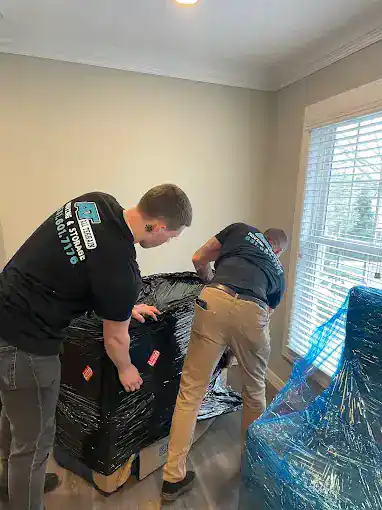
That’s where we come in. We handle the physical labor — loading, positioning, securing, and unloading — with the right equipment and the right technique for whatever you’re moving. For standard furniture, that’s manageable. For a 900-pound piano or a drained hot tub that still weighs over 600 pounds, it’s a different job entirely.
The container is just the box. What happens inside it — and getting things in and out without damage — is where experience actually matters.
Hot Tub Movers: Why This Is One of the Hardest Residential Moves There Is
Hot tubs look manageable until you try to move one. Even after draining, a standard spa weighs between 500 and 1,000 pounds. The shape is awkward, the acrylic shell is fragile, and most residential properties across Suffolk County — especially the older homes in communities like West Bay Shore, Bay Shore, and Islip, many built in the late 1950s and early 1960s — have exactly the kind of tight side yards, uneven terrain, and narrow gates that make this move genuinely difficult.
The most common DIY mistake is underestimating what it takes to tilt and rotate that kind of weight safely. Standard dollies aren’t rated for it. Improvised setups — pipes, furniture sliders, a few people guessing — are how acrylic shells crack, how decking gets destroyed, and how people end up with serious back injuries. One documented case involved a family who cracked their hot tub’s shell attempting to move it across their own lawn. The repair bill came close to the cost of a new spa. A professional crew completed the same type of move in under an hour.
We come with low-clearance dollies rated for the weight, coordinated team lifting protocols, and the kind of spatial awareness that only comes from doing this specific job dozens of times. We also know how to protect your property in the process — your deck boards, your lawn, your fence, and your floors if the tub is going through the house.
If your hot tub is going into a portable storage container during a renovation or between homes, that adds another layer of complexity. The container has a fixed floor height, a specific door width, and no room for error once you’re maneuvering something that size inside. This is not a job for guesswork.
Moving a Piano in Suffolk County: What Can Go Wrong and How to Prevent It
Pianos are one of the most technically demanding items to move — not just because of the weight, but because of what’s inside. An upright piano can weigh anywhere from 300 to 800 pounds. A baby grand runs 500 to 600 pounds, with legs that detach and a lid that requires separate handling. A concert grand can exceed 1,200 pounds. But beyond the weight, the instrument itself is sensitive. Improper tilting, sudden jolts, or inadequate padding can knock the soundboard, shift the action, or cause tuning damage that isn’t immediately obvious — and isn’t cheap to fix.
Suffolk County homes present specific challenges for piano moves. Older construction throughout communities like Huntington, Amityville, and Brentwood means narrower doorways, tighter hallways, and staircases that weren’t designed with a 600-pound instrument in mind. The Hamptons presents a different version of the same problem — high-value homes with custom millwork, hardwood floors, and grand pianos that cost more than most cars. One wrong step with an improperly padded dolly can gouge a floor that costs thousands to repair.
We use shoulder dollies that distribute weight across the crew’s bodies rather than hands, heavy furniture pads to protect the finish and the instrument’s exterior, and floor-protecting bootees on every job to prevent scuffing and gouging. Our approach is methodical — assess the path, plan the pivot points, communicate clearly at every step. That last part matters more than most people realize. When you’re maneuvering 700 pounds around a tight corner, every person on the crew needs to be on the same page in real time.
Moving a piano into or out of a portable storage container requires the same level of care, plus the added challenge of the container’s threshold and interior dimensions. We handle this routinely. An untrained crew improvises — and that’s when instruments get damaged.
Movers for Heavy Items: What Separates a Trained Crew from a Gamble
In the professional moving industry, any single item over 300 pounds is classified as ultra-heavy and requires specialized handling — different equipment, different crew coordination, and a different level of experience than a standard household move. That threshold matters because it’s where improvisation stops being an inconvenience and starts being a liability.
The problem in the New York market is that not every company advertising moving services has the training, equipment, or even the legal standing to handle these jobs. Unlicensed movers are a documented issue on Long Island — companies that quote low, show up with a rental truck and whoever was available that morning, and have no real recourse if something goes wrong. When you’re moving a piano, a hot tub, or a safe, that’s not a risk worth taking.
Building Movers and Large Structure Relocation: A Niche That Requires Real Experience
Most people don’t think about building movers until they need one — and then they realize quickly that this is one of the most specialized services in the moving industry. Moving a shed, a garage, a small outbuilding, or a modular structure isn’t a job that standard moving companies take on. It requires heavy equipment, careful planning around access and clearance, and in many cases, coordination with local permitting authorities.
In Suffolk County, this comes up more often than you’d expect. Homeowners relocating a detached garage to accommodate a renovation, repositioning a shed before a pool installation, or moving a modular structure from one part of a property to another — these are real situations that require a crew with the right equipment and the experience to assess what the job actually involves before committing to a price.
The same principles that apply to hot tub and piano moves apply here: the weight, the access challenges, and the potential for property damage if something goes wrong. Suffolk County’s older residential stock — many properties with mature landscaping, underground utilities, and limited side-yard clearance — adds complexity that an inexperienced crew won’t anticipate. We’ve been doing this work on Long Island for two decades and have seen these situations before. We know how to plan around them.
Permits may be required depending on the structure and the municipality. Suffolk County towns each have their own building department requirements, and what applies in Smithtown may differ from what’s required in Southampton or Babylon. We’re familiar with which questions to ask before the truck arrives.
How to Verify a Mover Is Legitimate Before You Hand Over Your Most Valuable Items
New York has some of the strictest consumer protection rules for movers in the country. The New York State Department of Transportation requires movers to hold a Certificate of Authority to Transport Household Goods, and any company operating vehicles over 10,000 pounds GVW needs a USDOT number. Interstate movers also need an MC number from the Federal Motor Carrier Safety Administration. Both are publicly searchable — you can verify them before you book.
This matters in Suffolk County specifically because the local market has a real unlicensed mover problem. The pattern is familiar: a low quote over the phone, a rental truck on move day, day laborers who’ve never met each other, and no real accountability if something gets damaged or goes missing. With high home values across the county — median sold prices hovering around $649,000 — the financial stakes of a bad hire are significant.
What to check before hiring any mover for heavy specialty items: confirm their USDOT number is active on the FMCSA website, ask for proof of insurance and request a Certificate of Insurance if your building or HOA requires one, verify they provide written estimates (required by law in New York), and make sure you understand exactly what’s included in the quote before anyone shows up. A company that won’t give you a written estimate before the job starts is a company that can change the number after the job ends.
Beyond the paperwork, ask directly whether the crew members are on-the-books employees or day laborers. It’s a simple question, and the answer tells you a lot. Trained, accountable employees who do this work every day handle a 700-pound hot tub differently than someone who showed up for a one-day gig. The difference shows up in how they move, how they communicate with each other, and what happens if something goes wrong.
Climate-controlled storage is worth asking about too, especially for specialty items that need temporary housing during a renovation or a multi-phase move. Pianos and antiques are sensitive to Long Island’s humidity swings and winter temperatures. Standard storage units don’t account for that. We offer secured, climate-controlled storage as part of our service, so you don’t need to coordinate a separate vendor.
Finding the Right Storage Container Movers in Suffolk County, NY
Heavy specialty moves — hot tubs, pianos, safes, building structures — require a specific kind of crew. The weight alone puts them in a different category, and the combination of older Suffolk County housing stock, high home values, and the real presence of unlicensed movers in this market makes choosing carefully more important than it might be elsewhere.
What you’re looking for is straightforward: verifiable credentials, on-the-books employees, written estimates, and a track record with the specific type of item you need moved. Experience with Long Island’s access challenges — the narrow hallways, the tight side yards, the older construction throughout communities from Huntington to the Hamptons — is worth more than a low quote from a company that’s never dealt with any of it.
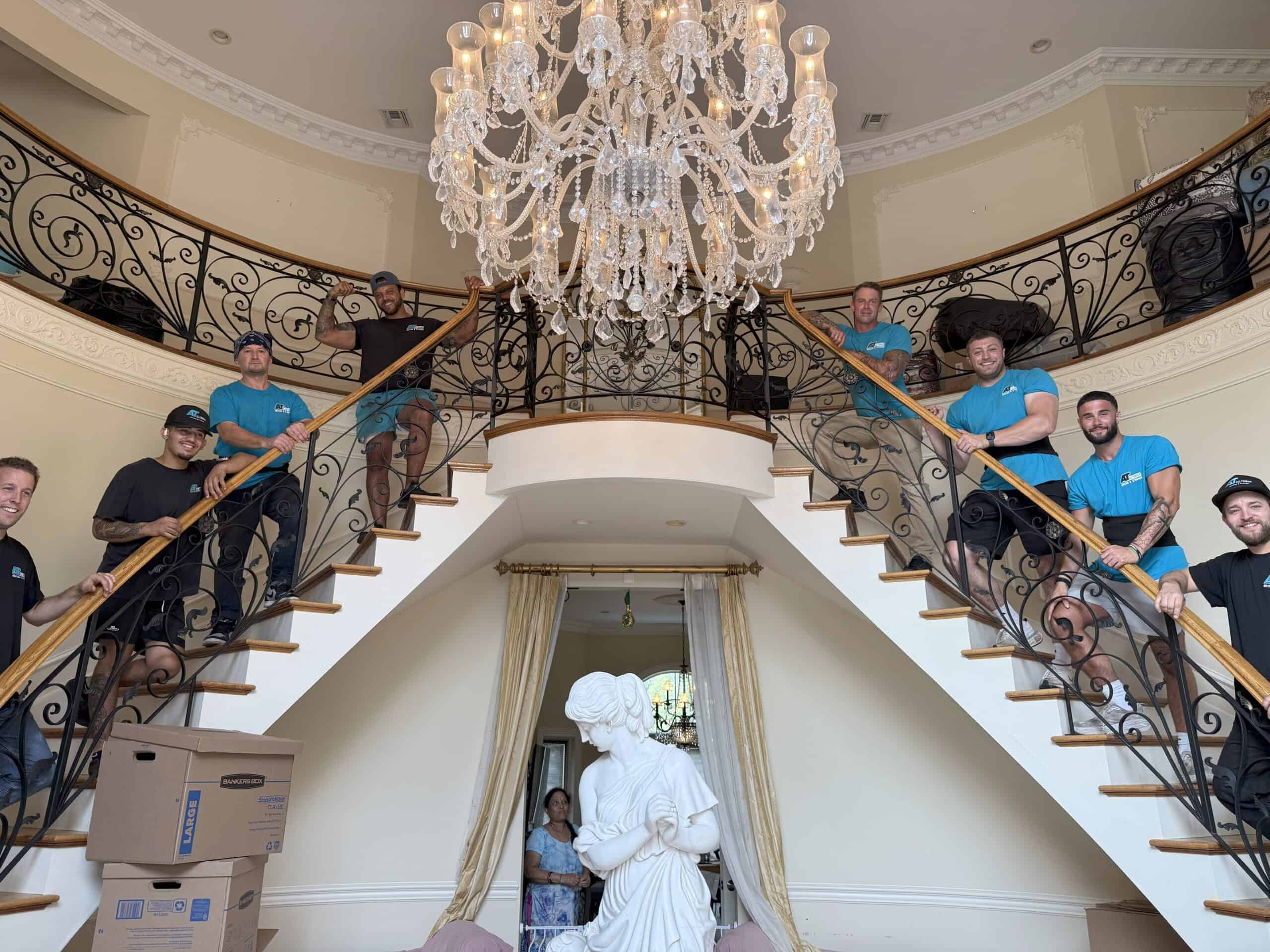
All Terrain Moving and Junk Removal Inc. has been doing this work in Suffolk County for 20 years. If you have a specialty item that needs to move — or a storage container that needs loading by people who actually know what they’re doing — give us a call at 631-601-7176. We’ll come out, assess the job in person, and give you a quote that doesn’t change when we show up.