

Summary:
You’ve probably already seen a few moving quotes that looked reasonable — until they weren’t. A low number gets your attention, then move day arrives and suddenly there are charges for stairs, fuel, a long carry from the truck to your door, and a weekend premium nobody mentioned. It’s one of the most common complaints in the industry, and it’s completely avoidable when you know what to look for.
This page breaks down how we calculate moving company costs in 2026, what fees tend to catch people off guard, and what the permit side of a move looks like here in Suffolk County, NY. By the end, you’ll know exactly what questions to ask — and what a straight answer looks like.
How Moving Company Costs Are Calculated in 2026
Moving costs aren’t random, but they’re not simple either. The final number depends on a combination of factors: how far you’re going, how much you’re moving, what services you need, and when you’re moving. Change any one of those variables and the price shifts.
For local moves — anything within Suffolk County or the surrounding region — we charge by the hour. In the New York metro area, that typically runs $70 to $90 per mover per hour, with most jobs requiring a crew of two to four people depending on the size of the home. A one-bedroom move might wrap up in three or four hours. A four-bedroom house in Huntington or Smithtown with a full basement is a different conversation entirely.
Long-distance moves switch to a different pricing model, usually based on total weight or cubic footage plus distance. The national average for a long-distance move in 2025 was $3,129, though moves out of the New York area tend to run higher given the regional cost of labor and fuel.
What Factors Drive Moving Costs Up — or Down
Distance and home size are the two biggest levers, but they’re far from the only ones. The time of year you move matters more than most people account for. Peak moving season runs from May through September, when demand is highest and availability is tightest. During those months — especially in Suffolk County, where the end of summer triggers a wave of Hamptons rental transitions and school-year relocations — prices reflect that demand. Moving in November or February, by contrast, often means more scheduling flexibility and the possibility of lower rates.
The day of the week and time of month also factor in. End-of-month moves are consistently busier because lease expirations cluster there. Mid-month weekday moves are typically the easiest to schedule and sometimes the most cost-effective. If your timeline is flexible, that’s worth knowing.
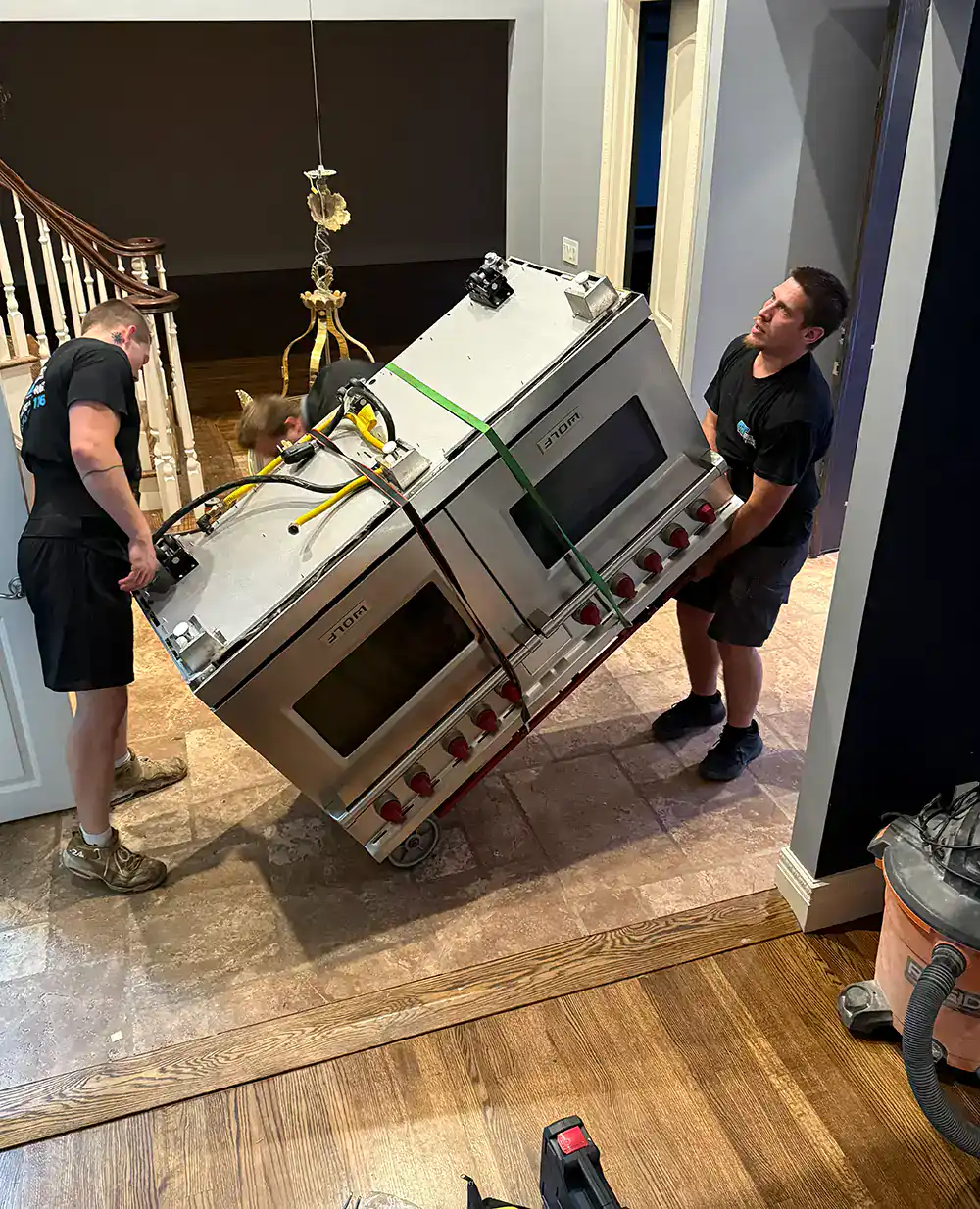
Services beyond basic loading and transport add cost, too — and legitimately so. Full-service packing, specialty item handling (pianos, safes, pool tables), disassembly and reassembly of furniture, and storage all carry their own line items. The question isn’t whether those services cost extra; it’s whether you knew about them before the truck showed up.
The access conditions at your origin and destination matter as well. A home in Babylon with a wide driveway and ground-floor entry is a straightforward job. A third-floor walkup in a Patchogue apartment complex, or a gated estate on the East End with a long approach from the road, introduces variables that affect time, crew size, and cost. When we visit your home before quoting you, we can account for all of this. A quote given over the phone cannot — and that gap is where most billing disputes originate. According to FMCSA data, sight-unseen estimates are 40% more likely to result in a final bill that exceeds the original quote.
Fuel costs are another variable that’s gotten harder to ignore. Moving company pricing has increased roughly 21% as of mid-2026 due to rising fuel costs, and some companies pass that along as a separate surcharge — sometimes disclosed upfront, sometimes not.
Hidden Moving Fees That Show Up After the Quote
This is the part most people wish someone had told them before they booked. The initial quote looks reasonable. Then the final invoice has a line item you don’t recognize, and suddenly you’re having an uncomfortable conversation on moving day when your belongings are already on the truck.
The BBB receives approximately 13,000 moving-related complaints every year, and the majority involve billing disputes — charges that weren’t in the original estimate. Most families end up paying $150 to $650 more than expected when fees aren’t disclosed upfront. Here’s what those fees typically look like.
Fuel surcharges are common and sometimes buried in the fine print. In 2026, these are projected to run between 7% and 12% of the base transportation rate depending on the company and the market. Long carry fees apply when movers have to carry your belongings more than 75 to 100 feet from the truck to your door — typically $50 to $150 per occurrence. In a community where parking access is limited or the driveway is set back from the street, this can apply at both ends of the move. Stair fees are charged per flight above the ground floor, usually $50 to $125 per flight, and can apply at both origin and destination. Weekend and holiday premiums are real at some companies — 10 to 20% added to the base rate, sometimes without being mentioned in the initial conversation.
Packing materials — boxes, tape, bubble wrap — are often quoted separately from labor. Shuttle fees apply when a full-size truck can’t access your street and a smaller vehicle has to ferry items back and forth, typically $300 to $800 depending on volume. And specialty item charges for pianos, safes, or oversized furniture are sometimes excluded from base estimates entirely.
None of these fees are inherently wrong. What’s wrong is when they’re not disclosed before you agree to anything. When we give you a written estimate, walk through your home in person, and guarantee the final cost matches the original quote, we remove all of this uncertainty. That’s the standard we hold ourselves to.
Moving Permit Costs in Suffolk County, NY
Permits aren’t something most people think about when planning a move — but depending on where you’re moving in Suffolk County, they can be a real part of the process. The good news is that we handle this for you. The better news is that Suffolk County is considerably less complicated than New York City on this front.
In NYC, moving permits involve over-dimensional vehicle applications at $35 per trip, Certificate of Insurance requirements filed with individual buildings, and borough-specific parking rules that can result in violations of $90 to $250 or more if you get it wrong. Suffolk County municipalities operate differently, with varying and generally more straightforward requirements.
What Moving Permits Cost in Suffolk County Towns
Suffolk County spans ten towns — from Huntington and Babylon in the west to Southampton and Riverhead in the east — and each municipality has its own rules around commercial vehicles on residential streets. There’s no single countywide permit requirement, which means the answer to “do I need a permit?” depends on where exactly you’re moving.
In general, moving-related permits in New York municipalities range from $25 to $200 depending on the town, the type of permit, and how long it’s needed. Some incorporated villages within Suffolk County require advance notice or approval for large commercial vehicles. Others have no formal permit requirement but do have weight restrictions or seasonal road rules that affect routing. We’ve been operating in Suffolk County for over 20 years, and we know which towns require what — we handle the applications as part of the job, not as an afterthought.
If you’re moving from a neighborhood in Commack to a home in Port Jefferson, or relocating from Ronkonkoma to somewhere on the East End, the logistics and any permit requirements are already familiar territory to us. That local knowledge is part of what you’re paying for when you hire a company that actually operates here.
For customers moving from Suffolk County to another state, the federal layer also applies. Interstate movers must hold a USDOT number and Motor Carrier authority — verifiable credentials that confirm we’re legally authorized to cross state lines. You can verify these numbers at protectyourmove.gov. If a company can’t or won’t provide them, that’s a clear signal to keep looking.
Do You Need a Trailer Moving Permit in New York?
A trailer moving permit — more formally called an over-dimensional or oversize vehicle permit — comes into play when the truck or trailer being used for your move exceeds standard size or weight limits for a given road or municipality. This is more common than people realize, particularly for large household moves, commercial relocations, or estate moves involving significant volume.
In New York State, over-dimensional vehicle permits are issued by the NYSDOT and, for New York City specifically, by the NYC DOT. The NYC permit costs $35 per trip and must be requested at least 48 hours in advance. Outside of the city — including throughout Suffolk County — the process is handled at the state or municipal level, and requirements vary based on the vehicle’s dimensions, the route, and the specific roads involved.
For most standard residential moves in Suffolk County, a trailer permit isn’t required. A typical 26-foot moving truck falls within normal operating parameters on most county roads. Where it becomes relevant is in situations involving very large moves, access-restricted areas, or routes that pass through incorporated villages with lower weight limits. The Hamptons — Southampton, East Hampton, Bridgehampton — include private roads, narrow lanes, and gated communities where vehicle access isn’t always straightforward. We assess this during the estimate and either route around it or handle the permit process before moving day.
The key takeaway is that permit requirements are a logistics detail, not a reason for surprise charges on your bill. If a permit is needed for your move, we identify that upfront, include it in the estimate, and handle the paperwork. It shouldn’t appear as a line item you’ve never heard of when the job is done.
How to Hire a Moving Company in Suffolk County Without Getting Burned
The single most useful thing you can take from this page is that price transparency isn’t a bonus feature — it’s the baseline. A moving company that gives you a written estimate, visits your home before quoting you, and guarantees the final cost matches the original number isn’t doing you a favor. That’s just how it should work.
If you’re planning a move anywhere in Suffolk County — whether that’s a two-bedroom in Bay Shore, a larger home in Dix Hills, or a seasonal property transition on the East End — the variables that affect your cost are knowable in advance. Distance, home size, access conditions, timing, services needed, and any applicable permit requirements can all be assessed before a single box gets loaded.
We’ve been doing exactly that for over 20 years, based right here in Islandia, NY. If you want a quote that holds, give us a call at 631-601-7176 — we’ll come to you, walk through the job, and give you a number you can count on.