Summary:
You asked for a quote. You described your place over the phone, maybe did a quick video walkthrough, and got a number that seemed reasonable. Then moving day arrived — and that number changed.
It happens more often than it should. And in most cases, it happens because the estimate was never based on what was actually in your home.
We offer in-person moving estimates for a reason. When a trained professional walks through your space, they see things a camera doesn’t catch and ask questions a form never thinks to ask. If you’re planning a move in Suffolk County, NY, this page will help you understand exactly why that difference matters — and what to look for when you’re choosing how to get quoted.
Virtual Moving Estimates Accuracy: What They Get Wrong
Virtual estimates have gotten more common over the last few years, and it’s easy to see the appeal. You schedule a video call, walk someone through your home on a screen, and get a quote without anyone having to show up. It sounds efficient.
The problem is that efficiency and accuracy are not the same thing. What a virtual estimator sees is limited to what you show them, how well the camera captures it, and what you remember to include. That’s a lot of variables working against you before the conversation even starts.
The gap between a virtual quote and your actual moving cost isn’t always our fault. Sometimes it’s just the nature of the format — and sometimes it’s the format being used to lowball you into booking.
What Virtual Moving Estimates Commonly Miss
Here’s where virtual surveys tend to fall short, and it’s more specific than most people realize.
Basements and attics are the most common blind spots. In a Suffolk County home — where roughly 80% of the county’s housing stock is detached single-family — there’s almost always a basement full of storage, an attic that hasn’t been touched in years, or a two-car garage with more in it than anyone’s accounted for. A video call captures what’s in front of you. It doesn’t capture what you forgot about.
Weight is another major issue. A solid oak dresser and a flat-pack dresser can look identical on a phone screen. In person, the difference is obvious the moment you put a hand on it. Weight drives cost — both in truck space and labor — and a virtual estimator is essentially guessing.
Then there are access points. The tight turn at the top of the staircase in an older Smithtown colonial. The narrow hallway in a Bay Shore split-level. The loading dock situation at a Hauppauge office building. These aren’t details you think to mention on a video call, but they’re exactly the details that determine how long a move takes and what equipment is needed. An estimator walking your home notices all of it.
Specialty items are also routinely underestimated or missed entirely. Pianos, safes, pool tables, antique furniture, oversized gym equipment — these items require specific handling, specific equipment, and sometimes specific crew. A virtual survey often captures them as just another piece of furniture. An in-person visit treats them for what they actually are.
The bottom line is that virtual estimates are built on assumptions. In-person estimates are built on what’s actually there.
Moving Estimate Reliability: Why the Format of Your Quote Matters
There are two types of moving estimates: binding and non-binding. Understanding the difference is important, but it’s only half the picture.
A binding estimate locks in your price. Whatever the estimator quotes, that’s what you pay — as long as no new services are added. A non-binding estimate is more of a projection. Under federal FMCSA regulations, a mover can charge up to 110% of a non-binding estimate at delivery, with any remaining balance billed separately. That means a non-binding estimate doesn’t cap what you owe. It just delays how much of it you find out about on moving day.
Here’s the part that connects directly to format: a binding estimate is only as reliable as the assessment behind it. If the estimator didn’t see your basement, didn’t know about the pool table, and didn’t walk the destination address, the binding number they gave you is based on incomplete information. That estimate may hold legally, but it won’t reflect the full scope of your move — and that gap has to be resolved somewhere, usually through add-ons or disputes.
An in-person estimate gives the estimator everything they need to quote you accurately and stand behind that number. When we walk through your home, we’re building a complete picture — room by room, item by item, access point by access point. That’s what makes a reliable quote possible. And it’s why our final cost matches the original quote. Not as a policy we’re proud of, but as a natural result of doing the assessment right the first time.
For Suffolk County homeowners — where median home values are pushing toward $700,000 and moves often involve decades of accumulated belongings across multiple floors — the stakes of an inaccurate estimate are real. Getting this part right isn’t optional.
Home Survey Moving: What a Professional In-Person Assessment Actually Covers
An in-person estimate isn’t just a formality. It’s a structured assessment that a trained professional uses to build an accurate, defensible quote — and it covers a lot more ground than most people expect.
The visit typically takes between 30 minutes and an hour, depending on the size of the home and the complexity of the move. During that time, the estimator is doing more than counting boxes. They’re evaluating weight, access, logistics, specialty items, and anything at the destination that could affect how the job gets done.
For most Suffolk County moves, that hour is one of the most useful investments you can make before moving day.
What Happens During an In-Person Moving Estimate in Suffolk County
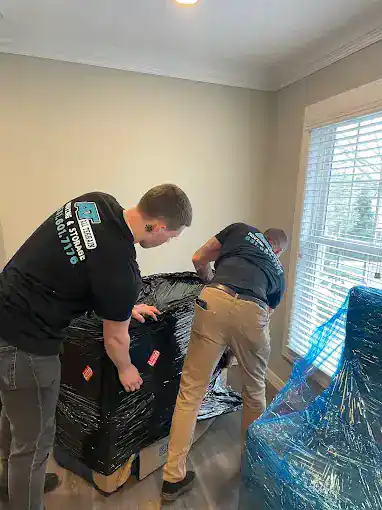
When we come to your home, the walkthrough starts with the obvious and works toward the things that are easy to overlook. Every room gets assessed — not just the ones you think to show us. That includes the garage, the basement, the attic, any storage areas, and any outbuildings on the property.
We’re looking at the items themselves, but we’re also looking at how they leave the house. Staircase configurations, hallway widths, doorframe clearances, elevator access if applicable, and parking logistics at both your current address and your destination. In Suffolk County, this matters more than people realize. The Northern State Parkway and Southern State Parkway both restrict commercial truck traffic, which affects routing and timing for moves across the county. That’s the kind of local knowledge that doesn’t show up in a virtual survey.
For moves to or from the Hamptons — Southampton, East Hampton, Sag Harbor — there are additional considerations: gated community access, HOA restrictions, limited parking in certain areas, and properties that often contain high-value items requiring specialized handling. An estimator who’s worked this county for years knows what questions to ask and what to look for before a crew ever shows up.
If you’re also dealing with items you don’t want to bring to your new place, that assessment happens during the same visit. We handle junk removal alongside moving, so the in-person estimate covers both. One visit, one quote, no second scheduling.
By the end of the walkthrough, you have a written estimate that reflects your actual move — not a projection based on square footage or a checklist you filled out online.
In-Person Estimates for Complex or Specialty Moves
Not every move is a standard two-bedroom apartment. And for the moves that aren’t, an in-person estimate isn’t just the better option — it’s the only responsible one.
Specialty items change the equation entirely. A piano requires specific equipment, specific crew positioning, and a clear path from the instrument’s current location to the truck. A safe — especially a floor-mounted or wall-mounted unit — involves different logistics still. Pool tables need to be disassembled properly to avoid damage and reassembled at the destination. None of these items can be accurately assessed from a video call, and none of them should be quoted off a general inventory form.
The same applies to commercial moves. If you’re relocating a medical practice in Huntington or a professional office in Hauppauge, the variables go beyond furniture count. Server equipment, reception desks, filing systems, and client-facing areas all need to be accounted for — along with the operational timeline, because downtime costs money. An in-person assessment gives us what we need to plan the move around your schedule, not ours.
There’s also the scenario that comes up more than people expect: the emergency move. When another company cancels the night before your lease ends, or a situation at home forces an unplanned relocation, an in-person estimate — even a rapid one — is how we make sure the crew shows up prepared. We offer same-day service across Long Island, and when that call comes in, we move fast. But we still want to know what we’re walking into.
For any move with real complexity — a large home, a specialty item, a tight timeline, or a high-value property — the in-person estimate is where the job actually starts.
Choosing the Right Moving Estimate Method for Your Suffolk County Move
If you’re comparing estimate options, the honest answer is straightforward: in-person estimates are more accurate, produce more reliable quotes, and give you a clearer picture of what moving day will actually look like. That’s true for most moves, and it’s especially true for the kind of homes and moves that are common across Suffolk County.
The 30 to 60 minutes it takes to walk through your home with a professional is a small investment compared to the cost of a moving day surprise. And when the estimate is done right — every room, every access point, every specialty item accounted for — the final bill shouldn’t surprise you at all.
If you’re planning a move in Suffolk County, NY and want an estimate you can actually rely on, reach out to All Terrain Moving and Junk Removal Inc. We’ll come to you, see what you’re working with, and give you a number that holds.
—
FREQUENTLY ASKED QUESTIONS
Are in-person moving estimates more accurate than virtual ones?
Yes, consistently. Virtual estimates rely on what you show the camera and what you remember to mention. When we walk through your home, we assess weight and access challenges directly, and account for specialty items that often go unnoticed on a video call. The result is a quote that reflects your actual move — not an approximation of it.
What do virtual moving estimates miss that in-person ones don’t?
The most common gaps are basement and attic storage, garage contents, specialty items like pianos or safes, and access challenges such as narrow staircases or tight hallways. In Suffolk County, where most homes are detached single-family properties with multiple floors and outbuildings, these gaps can add up quickly. A virtual estimate built on an incomplete picture will produce an incomplete number.
How long does an in-person moving estimate take?
Most in-person estimates take between 30 minutes and an hour. Larger homes or moves with specialty items may take a bit longer. The time is well spent — it’s what allows us to give you a quote you can actually plan around.
Will the final cost match what I was quoted?
Yes. Our final cost matches the original quote. That’s not a marketing line — it’s the direct result of doing the assessment thoroughly the first time. When we’ve seen everything, there’s nothing left to surprise us on moving day. For moves in Suffolk County, where properties often span multiple floors with basements, attics, and garages, this thoroughness is what sets an accurate estimate apart from one that misses critical details.
Can I get a moving and junk removal estimate at the same time?
Yes. We handle both moving and junk removal, so a single in-person visit covers everything. If you have items you’re leaving behind — furniture you don’t want, appliances, years of accumulated stuff in the basement — we assess that alongside the move. One visit, one conversation, one quote.